Letter to The Times: scrutiny of Jason Arday was legitimate
Following the sad death of Professor Jason Arday, many have been trying to control the narrative into the familiar one of blameless black victim versus racists. The racists according to their telling, are the press and academics who rightly subjected Professor Arday’s work and claims to scrutiny. This is part of a worrying trend to call for things that may be upsetting to be removed from our sight and sound: to be censored or regulated away. It is a similar kind of ‘uncaring kindness’ that Nigel Biggar explores in his comparative piece on Arday and the Church of England.
We cannot allow calls for censorship to flourish, so DDU’s director, Alka Sehgal Cuthbert, co-ordinated a joint letter to express our opposition. It was signed by many public figures across the range of politics and professions and was published in The Times on 25 August 2026.
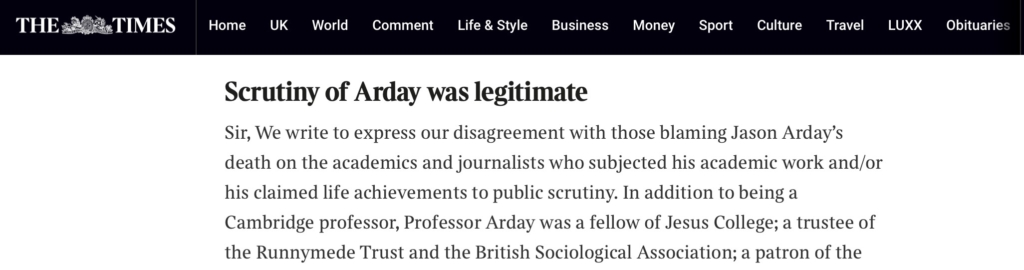
Sir, We write to express our disagreement with those blaming Jason Arday’s death on the academics and journalists who subjected his academic work and/or his claimed life achievements to public scrutiny. In addition to being a Cambridge professor, Professor Arday was a fellow of Jesus College; a trustee of the Runnymede Trust and the British Sociological Association; a patron of the Adult Literacy Trust and Get Further; and sat on various committees, including ITV’s cultural advisory council and the NHS race and health observatory academic reference group. Hence subjecting his work and apparently untrue claims to public scrutiny was entirely legitimate.
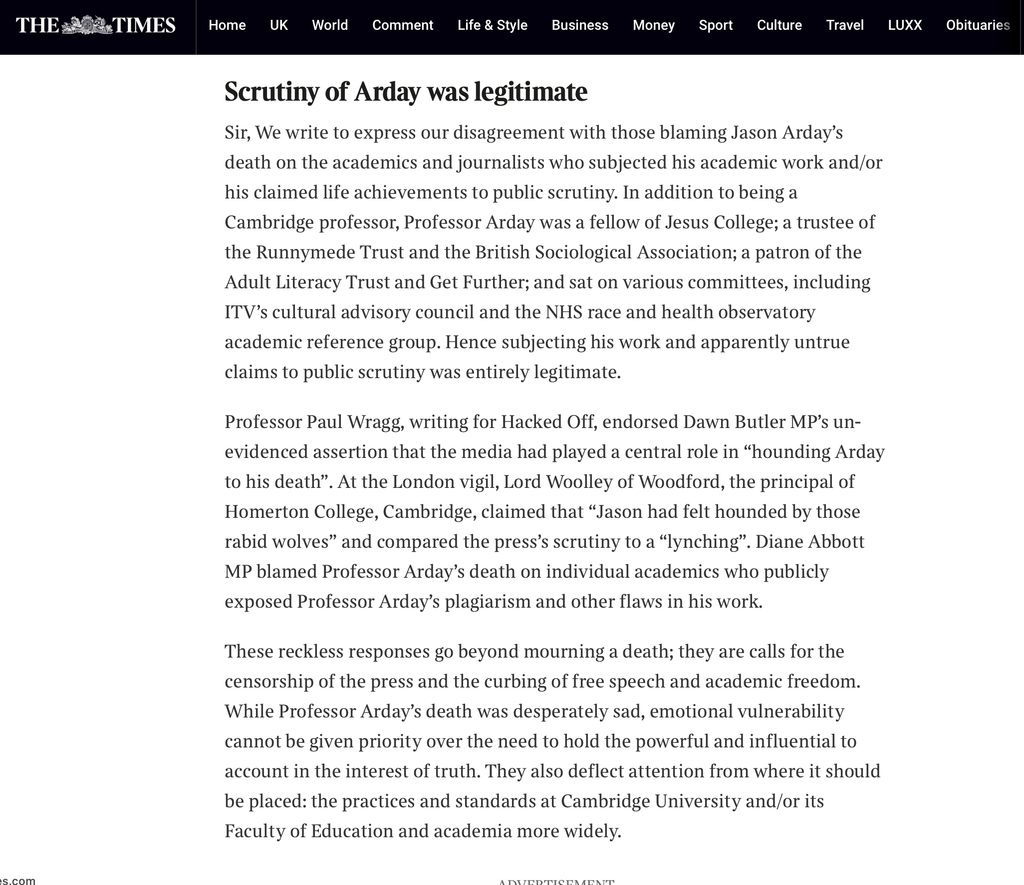
Professor Paul Wragg, writing for Hacked Off, endorsed Dawn Butler MP’s un-evidenced assertion that the media had played a central role in “hounding Arday to his death”. At the London vigil, Lord Woolley of Woodford, the principal of Homerton College, Cambridge, claimed that “Jason had felt hounded by those rabid wolves” and compared the press’s scrutiny to a “lynching”. Diane Abbott MP blamed Professor Arday’s death on individual academics who publicly exposed Professor Arday’s plagiarism and other flaws in his work.
These reckless responses go beyond mourning a death; they are calls for the censorship of the press and the curbing of free speech and academic freedom. While Professor Arday’s death was desperately sad, emotional vulnerability cannot be given priority over the need to hold the powerful and influential to account in the interest of truth. They also deflect attention from where it should be placed: the practices and standards at Cambridge University and/or its Faculty of Education and academia more widely.
Dr Alka Sehgal Cuthbert, director, Don’t Divide Us
Lord Young of Acton, director, Free Speech Union
Dr John Armstrong, KCL, London Universities Council for Academic Freedom
Tess Ashen, Student Academics for Academic Freedom
Lord Biggar of Castle Douglas
Professor Michael Ben-Gad, City St George’s, University of London
Lara Brown, the Spectator;
Ben Cobley, author of The Progress Trap
Alastair Donald, director, Living Freedom
Dr Wendy Earle, convenor, the Academy of Ideas Arts and Society Forum
Baroness Fox of Buckley, director, Academy of Ideas
Emeritus Professor Frank Furedi
Freddy Gray, deputy editor, the Spectator
Maeve Halligan
Julia Hartley-Brewer
Professor Dennis Hayes, director, Academics For Academic Freedom
Professor Eric Kauffman
Dr Marie Kawthar Daouda, lecturer, and author Not Your Victim
Brendan O’Neill, Spiked chief political writer
Edward Skidelsky, director, Committee for Academic Freedom
William Mackesy and Andrew Neish KC, co-founders, Alumni for Free Speech and Best Free Speech Practice
Dr Lisa McKenzie, senior lecturer in sociology
Bijan Omrani, author, God is an Englishman
Professor Ian Pace, City St George’s, University of London
the Rev Dr Ian Paul, member of General Synod, Church of England
Lord Roberts of Belgravia
Professor Abhishek Saha, Queen Mary University of London
Tom Slater, editor, Spiked
Hardeep Singh, journalist and author
Dr Stuart Waiton, chair of Scottish Union for Education
Ella Whelan, journalist
Charles Wide, KC
Dr Joanna Williams, journalist and author, Academic Freedom in an Age of Conformity
Guy Adams, feature writer, the Daily Mail