The TUC’s unduly pessimistic view of race relations at work
In April, the TUC commissioned polling which, they claimed, proved ‘shocking increase in racism at work’. But following the tragic murder of Henry Nowak, it is urgent that we treat disparities with proper critical scrutiny, to see if the inferred claim of racism is, in fact, true. Richard Norrie provides just such a thorough analysis of the TUC commissioned polling and concludes the picture is nowhere near as definitive or clear as presented.
A recent report published by the TUC, No Worker Left Behind: Black workers, workplace risk and the fight for equal protection, painted a dispiriting picture of race relations in Britain. Its authors claimed ‘many black workers still encounter hostile workplace cultures, structural barriers to progression and unsafe working conditions’.
Polling commissioned by the TUC found:
‘For black workers, the most common forms or racism and harassment experienced at work are:
- Racist jokes or ‘banter’ (41 per cent of all Black workers)
- Witnessing racist verbal of physical abuse (36 per cent)
- Racist remarks at you or in your presence (36 per cent)
- Verbal abuse at you or others (35 per cent)
- Questioning about your culture or religion in a way that was offensive or humiliating (35 per cent)’
Furthermore:
‘There has also been a concerning rise in the percentage of black workers who have experienced physical violence, threats and intimidation at work. It’s gone from an already too high 19 per cent in 2020 to 26 per cent in 2026.’
The polling was conducted by an organisation called Hold Sway. It is claimed a ‘nationally representative survey of 1,590 workers aged 16 and over in Great Britain’ was carried out earlier this year. The sample was made up of 1,044 Black workers and 509 white workers. Beyond this, scant detail of methodology and sampling are offered.
Hold Sway is a relatively new and small company, founded in 2023 by pollster Peter McLeod, who has strong links to the Labour Party. How the data are collected is not told. Quota sampling, whereby non-randomly selected individuals are chosen to match known demographic profiles, may have been used. The problem is, if there is a bias whereby people who have experienced racial abuse or discrimination are more likely to take part, then no amount of hammer and nails will curtail this. (I emailed Hold Sway requesting details of the methodology but received no response.)
Analysis of bigger and better government data sets offer a much more encouraging and nuanced picture of racial abuse and violence in Britain. The Crime Survey of England and Wales (CSEW) asks respondents if they have experienced harassment or intimidation. The figures for ethnic minorities are comparable to the TUC figures.
Table 1. Any harassment or intimidation because of your ethnicity in the last 12 months – Crime Survey England and Wales 2023/24 (weighted)
| No | Yes | |
| White | 97% | 3% |
| Mixed | 74% | 26% |
| Asian | 63% | 37% |
| Black | 67% | 34% |
| Other | 66% | 34% |
However, when CSEW asks if abusive or hurtful comments of any kind have been received, then the figures for ethnic minority groups drops in line with whites, excepting the mixed group. This suggests terms such as ‘harassment’ and ‘intimidation’ are interpreted to encompass things that are less direct and more intangible – ‘micro-aggressions’, etc.
Table 2. Any hurtful or abusive comments directed at you in the last 12 months – Crime Survey England and Wales 2023/24 (weighted)
| No | Yes | |
| White | 98% | 2% |
| Mixed | 91% | 9% |
| Asian | 99% | 2% |
| Black | 98% | 2% |
| Other | 98% | 2% |
Turning now to the Understanding Society data set, we find a less optimistic picture than CSEW, in terms of general insults/abuse. Ethnic minorities sometimes receive more, sometimes less depending on the group, relative to white British.
Table 3. Any insults in the last 12 months – Understanding Society Wave 11 (weighted)
| No | Yes | |
| White British | 87% | 13% |
| Indian | 89% | 11% |
| Pakistani | 88% | 12% |
| White other | 85% | 15% |
| White Irish | 90% | 10% |
| Bangladeshi | 86% | 14% |
| Mixed | 78% | 23% |
| Black African | 83% | 17% |
| Black Caribbean | 85% | 15% |
| Other Asian | 87% | 13% |
| Other | 80% | 20% |
| Chinese | 80% | 20% |
| Arab | 84% | 16% |
| Black other | 83% | 18% |
When we look at insults received based only on race, then we see whites get statistically none, while for minority groups, it ranges from about six to eight per cent, with some outliers likely down to small sample size – for example, Chinese.
Table 4. Any insulted received in last 12 months directed at ethnicity – Understanding Society Wave 11(weighted)
| Yes | No | |
| White British | 100% | 0% |
| White other | 99% | 1% |
| Indian | 94% | 6% |
| Mixed | 92% | 8% |
| Pakistani | 94% | 6% |
| White Irish | 100% | 0% |
| Black African | 90% | 10% |
| Black Caribbean | 96% | 5% |
| Bangladeshi | 94% | 6% |
| Asian other | 94% | 6% |
| Other | 89% | 11% |
| Arab | 98% | 2% |
| Chinese | 84% | 16% |
| Black other | 100% | 0% |
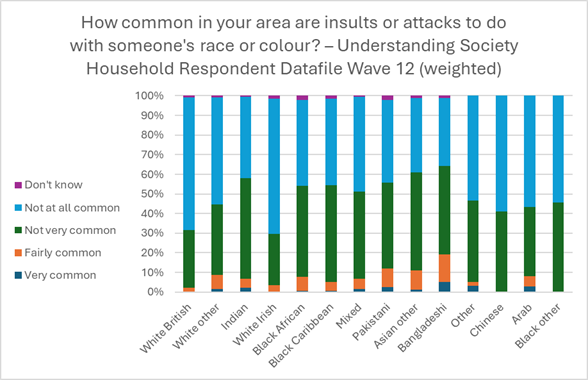
Finally, Understanding Society asks household heads how common racial insults and attacks are in their area. The results show large majorities of all groups saying they were ‘not very’ or ‘not at all common’.
Table 5. How common in your area are insults or attacks to do with someone’s race or colour? – Understanding Society Household Respondent Datafile Wave 12 (weighted)
| Very common | Fairly common | Not very common | Not at all common | Don’t know | |
| White British | 0% | 2% | 29% | 68% | 1% |
| White other | 2% | 7% | 36% | 55% | 1% |
| Indian | 2% | 5% | 51% | 42% | 0% |
| White Irish | 0% | 4% | 26% | 69% | 2% |
| Black African | 1% | 7% | 46% | 44% | 2% |
| Black Caribbean | 1% | 5% | 49% | 44% | 2% |
| Mixed | 2% | 5% | 44% | 48% | 1% |
| Pakistani | 3% | 9% | 44% | 42% | 2% |
| Asian other | 1% | 10% | 50% | 38% | 1% |
| Bangladeshi | 5% | 14% | 45% | 35% | 1% |
| Other | 3% | 2% | 42% | 53% | 0% |
| Chinese | 0% | 0% | 41% | 59% | 0% |
| Arab | 3% | 5% | 35% | 57% | 0% |
| Black other | 0% | 0% | 46% | 55% | 0% |
The TUC further found,
‘Black men are more likely than Black women to report… being passed over for or denied promotion (40 per cent compared to 35 per cent).’
Analysis by Policy Exchange found perceived discrimination in promotion to be much lower among ethnic minority groups. It found ‘just under 12 per cent of non-white respondents thought they had been discriminated against compared to 5.7 per cent of white British’. It was higher in the black Caribbean group at 18.2 per cent as well as the black African group, at 14.9 per cent – but lower for Pakistanis, Indians and Bangladeshis at around eight to 10 per cent. These figures are based on the old Citizenship survey from 2009/11, but present a much more optimistic picture. If we accept the TUC figures at face value, then what has the expansion of EDI actually achieved if the perception of discrimination has increased so markedly?
Yet, that is what the TUC effectively calls for more of. For example, the TUC calls on the government to:
- ‘Legislate at pace to introduce mandatory ethnicity pay-gap reporting for employers with more than 50 employees and require action plans to address identified disparities.’
- ‘Enforcement and regulation through the Worker Protection Act 2024 to require employers to prevent harassment where protected characteristics intersect.’
- ‘Fully deliver and enforce plan to Make Work Pay including statutory rights for equality representatives.’
Employers, amongst other things, are told to:
- ‘Implement comprehensive ethnicity and intersectional monitoring, including recruitment, retention, promotion, pay and grading, ethnicity pay gaps, training access, and disciplinary processes.’
Such measures will lead to significant compliance costs. If they are in response to a misreading of the problems involved based on questionable polling, then this confounds the issue. Ryan Breslow, who is the chief executive of the payment company Bolt, recently announced he had fired his entire HR team for ‘creating problems that didn’t exist’. As he said, ‘those problems disappeared when I let them go’. The number of people working in HR roles has increased by 83 per cent between 2011 and 2023, while productivity has stagnated.
Furthermore, the call for mandatory ethnicity pay-gap reporting for organisations with more than 50 employees is completely wrong-headed for the following reasons:
- A company with 50 employees in a place like Redcar may have at most just one or two non-white employees, producing statistics that fluctuate wildly from year to year;
- Ethnicity pay-gap reporting has been criticised for its impracticability, with the ONS recognising 19 ethnic groups, the potential for a meaningless data soup is large while simple ‘white vs. BME’ comparisons would obscure as much as they reveal;
- A 2019 government survey of employers found gender pay-gap reporting created much consternation at board level and lots of action plans, etc. But few employees seemed to care, with just two per cent of respondents reporting a widespread reaction. This suggests pay gaps are not the ‘burning injustice’ they are so regularly taken for by third parties, but rather reflective of other economic factors and circumstances far beyond control from on high.
- The record shows the gender pay-gap to be falling with no obvious hastening of the rate of change to coincide with mandatory gender pay-gap reporting – in other words, it doesn’t do anything;
- The Cabinet Office estimated the cost of gender pay-gap reporting was £463 in 2020 prices. This does not take into account ‘gold-plating’. Increasing unnecessary costs, particularly for small to medium concerns, is never welcome.
The TUC’s recommendations will only fuel further HR expansion to address problems that may be overstated. This stands not in the interests of the typical worker of any ethnicity, never mind those who work with their hands. Presenting an unduly pessimistic picture based on tendentious statistics will only serve to lower expectations, leading to ambitious minority youths not going for that promotion or job opportunity.
Richard Norrie is a researcher who has worked for Civitas and Policy Exchange.