Henry Nowak: policing for diversity and anti-racism is bound to fail the general public
What weird world are we in where an innocent murder victim dies in police handcuffs while his killer looks on?
The manner of Henry Nowak’s death has been the subject of fierce debate since the start of June when footage was released of his arrest for alleged racist abuse – a wholly false allegation made by the man, Vickrum Singh Digwa, by whom he had already been fatally stabbed.
From the various attempts to account for this awful absurdity, two opposing explanations have emerged: either gross incompetence on the part of the police; or two-tier policing that is prejudiced against whites. Neither of these answers will suffice, since neither understands how much is at stake.
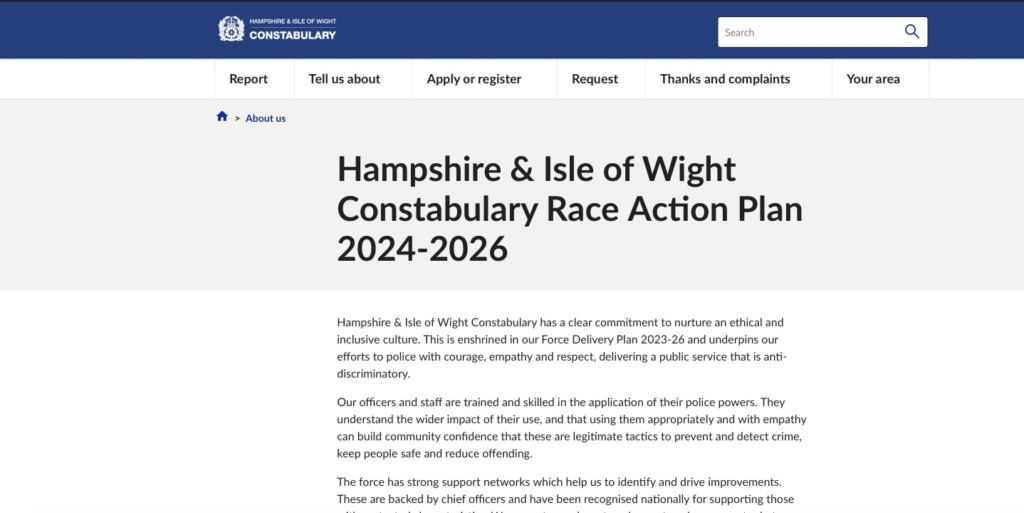
My best answer is that EDI training and legal developments such as the Equality Act have cautioned public servants against using their common sense, and this will have drastically increased the level of incompetence among Southampton’s police on the night of Henry Nowak’s tragic murder – to the point where, largely as a result of such initiatives, the constables concerned were no longer fit to act as officers of the law.
Footage from the cameras worn by officers attending the scene of Henry Nowak’s murder suggests they lacked basic human instincts and the nous that normally goes with it. But if they didn’t act humanely or intelligently, either they were innately psychotic and stupid or, as seems more likely, they had been taught not to trust their instincts, not to read the situation instinctively and act accordingly, since their instinctive reading – so they will have been repeatedly told – could only be tainted by unconscious bias.
You must not speak or act without first checking your privilege – without reining in and re-directing your fundamentally flawed self. This is the message of EDI training and it is essentially at odds with the self-confidence required of public servants in the competent execution of their duties.
According to the adherents of EDI, awareness of unconscious bias will raise, not lower, the level of a police officer’s service to the public. What this approach fails to acknowledge is that EDI initiatives and their legislative counterpart, chiefly the Equality Act, jointly undermine the very idea of the public. In so doing, they also remove the basis for public service from underneath the feet of public servants.
The police, for example, instead of acting against criminals on behalf of the general public, are called upon to act as referees between diverse social groups which, conversely, are expected to call on the police to protect their particular qualities, designated as ‘protected characteristics’ under the terms of the Equality Act. This is the expectation that Digwa played into, cynically and successfully, when he falsely accused Harry Nowak of racism; rather than losing the plot, the police officers duly played their part in the recently templated storyline. But this is also the narrative structure by which the Equality Act defines who we all are in Britain today – a babel of competing identities rather than a patriotic general public.
Protected characteristics articulate and legally consolidate already established cultural beliefs of multiculturalism and identity politics. Repealing the Equality Act (the heart of which is the radical innovation of protected characteristics), partially or in full, would not suddenly create a ready formed public. But it is a necessary precondition for us to live with each other as free, morally autonomous individuals rather than representatives of administratively created ‘identities’.
Some commentators correctly insist that the police were not momentarily wrong-footed by a short course in EDI. It wasn’t that they took a second to tick the box, and then behaved as we would expect of public servants. Their continuing misjudgment, as seen in the body cam footage, indicates that their overall training had been poor, such that their appalling actions resulted from institutional confusion and decline rather than a momentary lapse by a couple of sub-par individuals. But claims of ‘two-tier policing’ and ‘institutional racism against whites’ accord unwarranted consistency to government policy and its implementation by the police. In all its aspects, the British state today is characterised by hidden superficiality rather than hidden depths.
While there is now a legislative framework for the identity narrative, masquerading as the story of the nation, this goes against the grain of English common law, which has resisted successive attempts to erase it entirely; and it sits unhappily with a largely free people, of which the majority has lost neither its common sense nor the capacity to come together around a sense of fair play (regardless of protected or unprotected characteristics).
In this context, demands along the lines of ‘rights for whites’ can only be a reversed-out version of identity politics, in which whites instead of blacks are held up as the aggrieved party. Such an embrace of victimhood amounts to the further abdication of our individual responsibility to act as members of the general public, and the concomitant duty of public servants to uphold the law on our collective behalf.
Alka Sehgal Cuthbert is director of Don’t Divide Us.