Some example questions for parents who suspect impartiality requirements have not been met
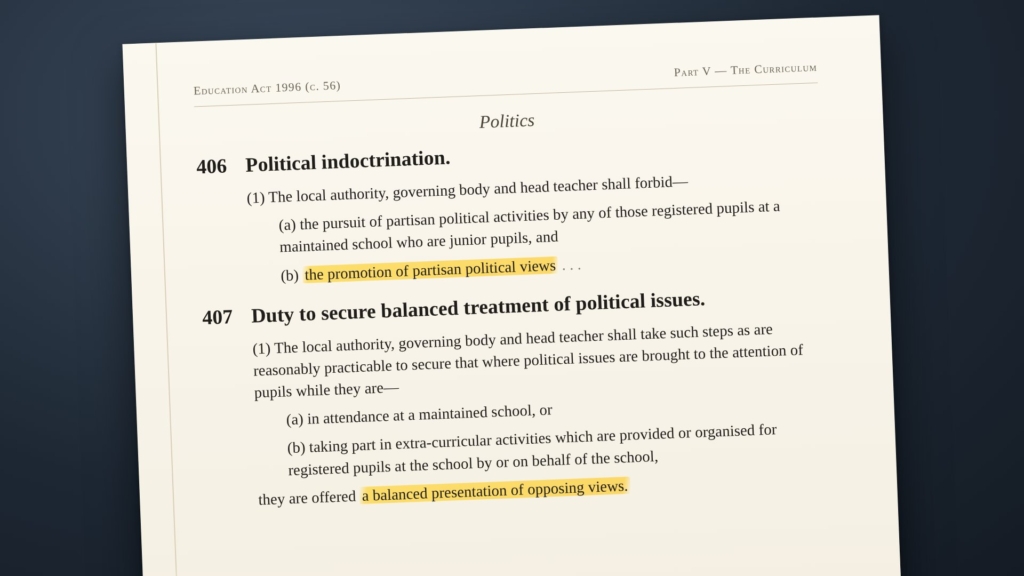
If you find that your child’s school may be in breach of Sections 406 and 407 of the Education Act, and the guidelines which provide more information about impartiality in schools, here are some example questions you could use, or adapt, in communicating with the school.
Impartiality is not limited to party politics. The issues of intentionality, or a minimum number of lessons or books required in order to be in breach of the requirements, remain unclarified by the government. This is far from ideal. The questions here cover prior due diligence, copyright & materials, and workshop content & related themes.
Please do get in touch if you think a school may be in breach, we would like to compile a folder of examples for future advocacy work.
Prior Due Diligence
1. Were you aware of the DfE guidance that schools should ‘thoroughly assess external agencies before agreeing to any work with them‘ when you considered engaging them?
2. Did you thoroughly assess [name of third-party organisation] before deciding to engage them?
3. Before engaging [xxxxx]:
- Did you review their website?
- Did you review any publications and related material produced by [xxxx] aimed at schoolchildren?
- Did you assess [xxxxx] wider partisan political views? This need not be confined to party politics only, but can be broader political world views on, for example, where only one response is presented to climate change, immigration, open borders.
- Did you review an outline or explanation of the proposed workshop/session/course?
- Did you carry out any other checks you would like me to know about? If so, please comment briefly.
4. Who carried out the due diligence assessment of [xxxx]?
5. Who approved the decision to engage [xxxxx]?
6. Do you accept that [xxxxx] is an avowedly activist organisation and that some of its published positions constitute partisan political views within the meaning of the DfE guidance? [1]
7. Were any written instructions or restrictions agreed with [xxxx] about topics or views that should not be promoted? [2]
8. Does documentary evidence of the due diligence process exist, including emails, notes, correspondence, risk assessments, instructions or agreements? If so, will you provide it?
9. Do you accept that if [xxxx] gave a workshop at your school in which all of the wider partisan political views they hold were presented as fact, without restriction and appropriate balance, then you would potentially be acting unlawfully?
Copyright and Materials – for schools who are unwilling to share materials with parents
1. Do you accept that you previously asserted that the [xxxxx] workshop slides could not be sent to me because of copyright restrictions?
2. Are you aware that DfE guidance says copyright ‘should never be used as a reason to refuse to share’ materials with parents?
3. Are you aware that the DfE says contractual clauses seeking to prevent any material at all being shared with parents are ‘void and unenforceable’?
4. Do you accept that DfE guidance expressly provides for materials to be shared with parents through various means, including a parent portal and controlled copies?
5. Do any other workshop delivery materials exist — including facilitator notes, scripts, activity sheets, prompts, handouts, videos, links or recommended resources? Will you provide them?
6. Will you provide slides and other relevant materials by email, parent portal, secure link or another controlled means allowing my independent review as a parent?
9. Do you accept that there is a substantive practical difference between ‘sharing’ materials in a way that allows independent review by a parent and merely ‘showing‘ those materials during a meeting?
Workshop Content and Related Items
1. Do you accept that the terms ‘white privilege”, ‘white supremacy’ and ‘micro aggressions’ refer to political beliefs from critical social and race theory?
2. Do you accept that these terms are contested?
3. Do you accept that terms including ‘change-makers’ when used to encourage pupils to take action are, in effect, encouraging political activism and therefore liable to be in breach of the requirements for impartial teaching?
4. Does the workshop/session/course contain any promotion of [xxxx] or affiliated organisations, including books, campaigns, petitions, websites, social media, links or QR codes?
5. Were any written instructions or reminders given to [xxxx] after engagement but before delivery of the workshop to ensure compliance with your political impartiality duties and DfE guidance? If so, will you provide them?
6. How long does the workshop/session/course last for each pupil?
7. When was the last workshop by [xxxxx]?
8. Has there been an evaluation of the workshop/session/course? If so, will you share the evaluation with parents? If not, is an evaluation planned?
9. Are dates scheduled for further workshops/sessions/courses by [xxxxxx]?
[1] This may involve some investigating websites for information about main presenters or authors involved. For example, Onjali Q Raúf is the author of The Boy at the Back of the Class where the main character is a refugee child. It has been used in class to teach kindness and letter-writing skills, but the author is also founder of a charity for refugee aid that supports open borders.
[2] This may be implicit rather than explicit. For example, if a book is used where the only character who does not like refugees is the nasty school bully, and it is assumed that any critical view of open boarders is beyond the moral or political pale, and no discussion or alternative views is provided, then it is reasonable to infer that only one view of a controversial topic has been presented and that the school has failed to ensure impartial teaching.