Where’s the substance? Whether or not Jason Arday was guilty of plagiarism, today’s ‘educational research’ is largely lacking in substance
DDU’s Director offers a reflection on the deeper institutional developments that have provided the context for not only the meteoric rise and tragic fall of Jason Arday, but have reconfigured official understanding of education, schools, and knowledge itself.
What more is to be said about the tragic death of Jason Arday? Having offered condolences to his family and friends, while hoping (against the odds) that the public blame game comes to a swift end, it’s surely not too soon to discuss the changing expectations of education and academia that set the tone both for Arday’s giddy ascent and for his sad demise.
Arday was accorded the highest academic status even though he had gained little intellectual authority. What accounts for this mismatch? Was the Cambridge Faculty of Education, which appointed him professor, a greater fantasist than Arday himself appears to have been? Has one of the world’s most venerable institutions – Cambridge University – entered a fantasy world in which social media-friendly identity is afforded greater weight than academic rigour? A brief history of the study of education in Cambridge gives some insight into how the Faculty – of which I myself am a former doctoral student – may have come to lose its faculties.
Recasting vocation into skillset
In 2000, Regent House, the governing body of Cambridge University, agreed to incorporate Homerton – a teacher-training college since 1894 – as a constituent college of the University. The convergence was completed in 2010. In 1993, the University had also incorporated the Cambridge Institute of Education, hitherto an independent charity with a remit to co-ordinate provision of teacher training and curriculum.
These changes were more than organisational or architectural. From its establishment in 2001, the focus for the new Faculty of Education shifted from the practice of teaching in schools towards teaching and schools as objects of research. This was presented as an attempt to modernise and professionalise one of the most fundamental things a society does: educate its young.
The significance of turning a vocation-based model of teaching into a research-based model received little public attention outside educational philosophy departments; and by this point, among educationalists, philosophy had been largely overtaken by sociology as a source of intellectual authority.
A proper Sociology of Education
The 1963 Robbins Report had proposed bringing Britain’s ad hoc teacher-training provision into university education. In 1976, Prime Minister James Callaghan’s speech at Ruskin College, Oxford advocated a closer relationship between universities and business. Whereas Robbins had called for teacher training to be transformed into a university degree programme – that is, an ethically liberal and humane endeavour of learning in pursuit of truth – speaking as the final curtain came down on the long postwar boom, Callaghan declared that university education should become more like professional training.
At Cambridge, the letter of the former has been followed – Homerton teacher-training college duly became part of the University. But the resulting Faculty of Education has oriented itself towards the latter: instead of teaching as a vocation, its pseudo-scientific research informs the teaching of teaching as a form of quasi-business practice, technical process or social justice; the three are not mutually exclusive.
‘Evidence-based educational research’, as offered by the Faculty, is a poor substitute for philosophy or sociology and/or teaching practice, since it restricts itself to seeking patterns within selected phenomena; conversely, it does not attempt to delve more deeply, via close adherence to disciplinary knowledge, into the reasons for human action. This is a lightweight form of research which makes heavy use of jargon to offset its essential lack of substance. Moreover, it attracts lightweight researchers whose lack of substance will likely go unchallenged because the field itself is less than challenging.
Whether meeting societal requirements as defined by politicians is the proper task of education is a question which few have asked – either in 1976 or in 2026. One of the few scholars who did raise such questions was my own PhD supervisor, the late Rob Moore, who was, ironically, a senior lecturer at the Faculty of Education at Cambridge.
A major insight of his work, grounded in canonical texts by Emile Durkheim and Basil Bernstein, was that the school curriculum typically becomes an object of public controversy as and when the cohort of current pupils undergoes significant demographic change.
For example, the baby boom of the postwar years expanded the cohort of pupils enormously. Additional policy initiatives, such as raising the school leaving age from 15 to 16 in 1972, further increased the number of children in secondary education at a stroke. The increase was especially evident in schools populated by working-class teenagers, many of whom might otherwise have left school for work, often through family networks. This expansion meant that many more secondary school teachers were required – far more than existing arrangements could supply. Hence the creation of academic education departments was, in part, an attempt to meet this requirement.
More recent demographic changes due to expanding immigration have similarly placed pressures on education – not only on buildings and staffing, but even more so on curricula. The expansion of EDI in education needs to be seen in this context, as well as through the lens of politics and identity. In the 1970s, the pressure on the curriculum took the form of calls to end a tripartite school system and its two-tier examination system of O-Levels and CSEs, which was considered elitist by Labour politicians. Today’s pressure takes the form of calls to remove or reframe canonical or disciplinary knowledge which is considered too white or colonial.
Moore, a man of the (traditional) left, was one of the first British sociologists of education to point out that egalitarian educational initiatives have come at a cost, especially when a commitment to a standard of truth is undervalued or, even worse, intentionally abandoned. The result is that what counts as legitimate knowledge for educational use – ie, the curriculum – changes fundamentally. Of course, changes per se can be better or worse. But if the former, intellectual judgment and ethical courage will have been required – two qualities conspicuous by their absence in the upper echelons of today’s academic educationalists. Moore supported a social-realist understanding of knowledge and education. He argued that this model entailed maintaining internal knowledge boundaries without which school curriculum becomes more vulnerable to external pressures. Today, this would include decolonising critical social justice advocates working in education. Developments since his death in 2014 support his case.
Back to the Faculty of Education
In 2001, Cambridge University’s transformation of a traditional teaching college into the Faculty of Education also signalled the transformation of the UK’s model of what a teacher is, and the legitimate knowledge they need. The new model is that of the teacher-researcher; inducted in methods of research, statistical software, social justice for women, peace studies, and so forth – but without the foundational disciplines of teacher education.
This corrosive transformation arose partly as a response among university education departments to government policy. A significant initiative was the introduction of the National Curriculum for Initial Teacher Training by the Conservatives in 1997, but taken up and consolidated by Labour in 1998. From being understood as the pursuit of truth directed by and towards a greater good, education, and then curriculum knowledge itself, was transformed into empirically observable competencies. One result has been that research itself, particularly in education departments, has become easily reduced to either radical, under-theorised empiricism, or pure speculative critical theory which, eschewing any empirical proxy, is both unfalsifiable and indigestible. Neither are of use to man or beast.
Thus, the Faculty of Education replaced the pre-existing Bachelor of Education (B.Ed) degree with a three-year BA in Education plus a one-year Post Graduate Certificate of Education. B.Eds, introduced in the 1960s, had been an attempt to make teacher education more systematic and deepen the knowledge content compared to the older Teacher Certificates. Accordingly, a B.Ed (Hons) degree required four years of study comprising, four components:
- Main subject study – to an equivalent level as a BA or BSc
- Educational Studies – the four core disciplines of philosophy, sociology, psychology, history of education, plus child development
- Professional Curriculum Studies – methods of teaching specific subjects, curriculum design and teaching practice
- Teaching Practice – substantial blocs of supervised practice in school placement, assessed alongside academic work. A dissertation or extended study would be required for honours candidates.
As a model, we can see this was an attempt to professionalise what had previously been understood in terms of vocation, and accredited on a more ad hoc basis. Hence the B.Eds offered teachers a robust and logically coherent course of study and practice.
A book from a series intended for student teachers during the 1960s and 1970s, the Students Library of Education, illustrates the level of general education, as well as specialised knowledge, which was expected of teachers. Spelling: Caught or Taught?1 by Margaret L. Peters, is a clear and compelling explanation of why spelling is important: good spelling ‘is connected with freedom to write’. Her account is educationally, rather than politically, informed. She explains why spelling cannot be ‘caught’ from reading because the latter requires going from the unknown (word), via the context, to the known word. Writing is the opposite: it requires going from the known (the spoken word) to the unknown (the written word). It involves a move between two modes of linguistic symbolisation and is close to translation between two languages.
The kind of authority which Peters’s work exudes, garnered from years of scholarly study and experience, does not depend on any of the titular credentials which are so highly valued today. Comparison with Cambridge Faculty of Education’s website for its course, PGCE Early and General Primary Core Subjects, is instructive with regard to the model of writing which is now held:
The development and transition of children’s writing from emergent mark making to a fluent style is explored. Practical workshops support investigations into the writing process.
The over-generalised jargon hides a multitude of errors. The transition mentioned is not one teachers need to ‘explore’: they need to know its full significance and how best to help their pupils make that transition. Practical workshops will reveal little unless accompanied by thorough reading, thinking and critique, as evidenced in essays by student teachers. As for ‘emergent mark making’, could this refer to my infantile squiggles on writing paper which my mum insisted looked a lot like her handwriting?
By contrast, the proper disciplinary fields for studying processes of writing development are child psychology, language development, and the aesthetics of literature. The actual reading list for the Primary English PGCE course is not publicly available, but the website says that the course is underpinned by ‘a philosophy’ that ‘high-quality literature for children and high-quality writing from children are linked’. Would-be teachers are directed to read picture books, novels, poetry, non-fiction, digital texts and film, the aim being to develop teachers who are ‘fluent and competent in teaching early reading’.
Extensive reading of books for children is indeed required, but for teaching well, the disciplinary knowledge evinced in Peters work is necessary; and she offers sound practical guidance for teachers on how to utilise what she could safely assume was prior knowledge on the part of her student-teacher readers. From its website, however, we can infer that the Cambridge Faculty of Education currently promotes a model of English teaching, contra Peters, which assumes that writing is mainly ‘caught’ from reading.
The disregard for knowledge as a good in itself has first encouraged education to be mis-recognised as both a business-oriented science (for educationalists), as spontaneous activity (for pupils) and more recently, as a site to pursue directly political goals. Far better if teaching were highly and properly regarded as a vocation to undertake the induction of the young into both the disciplinary based curriculum knowledge and the wider culture achieved by their elders.
Back to Jason Arday and EDI
As promoted by the Cambridge Faculty of Education, the model of teacher as researcher is intrinsically flawed because there is no generic discipline of Education in which to conduct research. Unlike the sociology of education or the philosophy of education, ‘evidence-based educational research’ is to the overall detriment of academia since it entails the eclipse of epistemological criteria and disciplinary boundaries, even at the world’s most prestigious universities in the world. This is the context in which the groundless claims of EDI could readily take hold, and Jason Arday could be appointed professor – more accurately, manipulated into the role of mascot for decolonisation.
Days before his sad death, Cambridge University announced a two-stage investigation into the circumstances surrounding Professor Arday’s appointment in 2022. It will be led by academics from Cambridge and other institutions. There are assurances that the findings of this inquiry will inform how senior academic appointments will be made in future, although no timeline has been provided yet.
It would compound the tragedy of Jason Arday if we get no further than angry calls to end EDI, or a tinkering at the margins of academic recruitment policy. Yes, EDI needs to go. But without a better intellectual and ethical alternative, it is likely to be replaced by another, equally divisive variation which takes the reality of neither education nor knowledge seriously.
One significant, generalisable step which the Department of Education could consider is the introduction of a minimum age requirement for professorships. This might help to revive the traditional idea of a professor as a learned scholar possessing wisdom and, hopefully, the life experience to withstand legitimate pressures and criticism.
A future Department of Education might also want to look at the reading lists and disciplinary content of education departments nationally, having decided which model of education and knowledge is better: a liberal general education for all with a curriculum derived from disciplinary knowledge, up to the point where students can choose between vocational courses, paid work or further academic study; or, a fluctuating model of ‘relevance’ for what is an ever-changing labour market, plus critical social justice.
Hopefully, it will not be too long before a choice such as this is put before the British electorate. In the event that the party manifestos do address this question at the next general election, with all due respect to his family and friends, I might then presume to say that Jason Arday will not have died in vain.
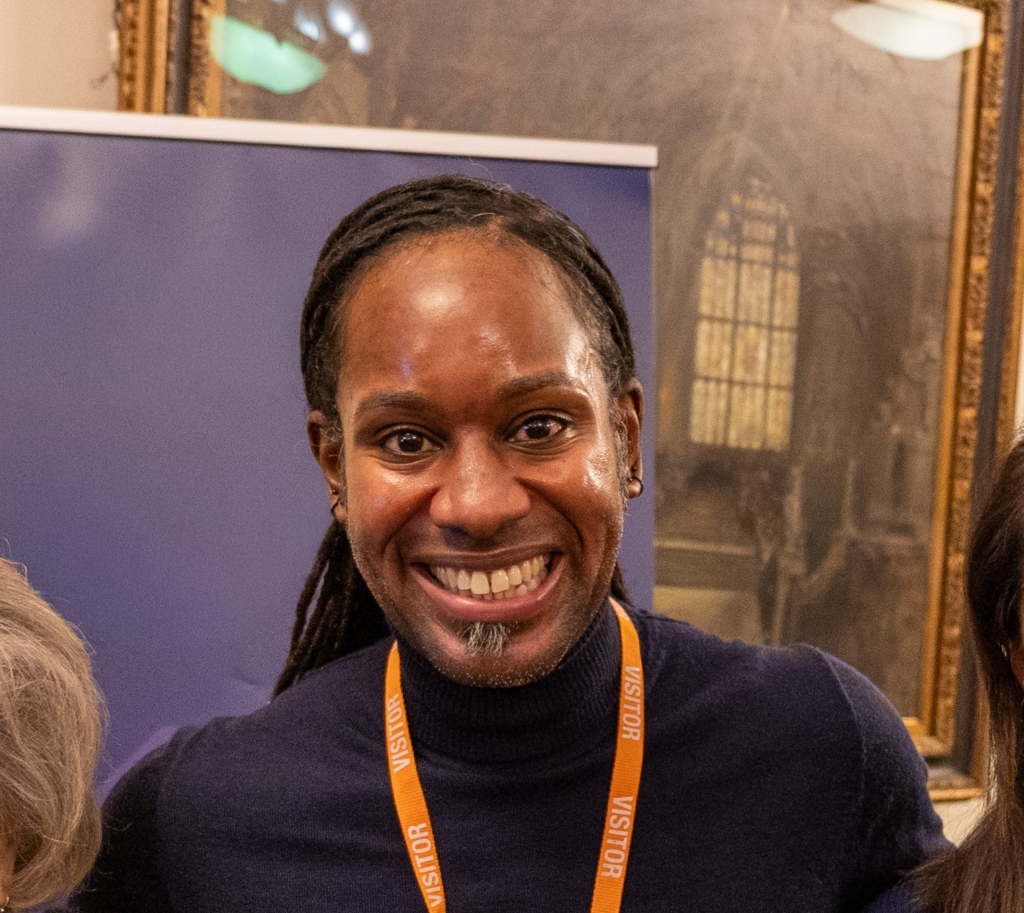
Photo: Jason Arday in 2024 (ConiferousForest19, via Wikimedia Commons)